A basic truth in life is that the things we care about deeply have the greatest ability to hurt us. This is true whether it is in relationship to another person, sport, career, or any other passion. If you don’t genuinely care about something (or someone) it can’t break your heart. The paradox at the core of love and pain is undeniable: they are interconnected and inseparable. And yet, to disconnect and not care at all is not a desirable or healthy path. In my seventeen years as a psychotherapist, I’ve never once had someone tell me their goal is to live an apathetic life. Apathy is the absence of emotion, the absence of feeling and care. It is an emotional void. Most people who experience chronic apathy seek counselling because they feel tormented by a lack of feeling, often in the form of what we clinically refer to as major depressive disorder.
To care means to take risk, to invest emotion, time, attention, energy, with the hope of gains. This process is scary because when we invest and we lose, it hurts. But there are different kinds of hurt. Senseless hurt and hurt with a purpose. Experiencing growth-related hurt in pursuit of something we care about is meaningful, it is not senseless. It is also almost always inevitable as we evolve and calibrate our plan, performance, and path along the way. Choosing what (or who) we love and how we go about nurturing that relationship matters in our gains and losses. Part of nurturing the relationship is to normalize and make space for setbacks, for hurts, for stumbles, falls, missteps and failures along the way.
Experiencing growth-related hurt in pursuit of something we care about is meaningful, not senseless.
As humans we are wired to seek the path of least resistance. And, in my lifetime, I have watched the world evolve to become more accommodating to the “easy” life. I am old enough to remember the invention of the internet. The smart phone. Social media. And while these technologies have brought us many positive outcomes, they also make it easy to be disconnected from what we care about – taking time to invest in something deeply is hard work, getting a quick hit of dopamine from social media is easy.
I highlight this because I see many people seek therapy when they care deeply and their heart gets broken – a failed test, a break-up of a romantic relationship, a DNF in an important race. These situations break our hearts because we dared to care, to try, and our outcome came up short of our hopes and dreams. This Fu*king hurts, there’s no way around it. And… it’s not the end of the story. Not if we step back and zoom out and see that this is part of it – the hurt, the pain, the reflection, learning, recalibration – these are part of the care and love of a good life.
Make your mind your friend, not your enemy. It’s a game changer for performance.
So, knowing that love comes with hurt, gain comes with pain, passion comes with heartbreak, how do we manage this when it happens? While we can’t control or avoid these setbacks, we can learn to navigate them effectively, and that process starts with how we manage our mind. Make your mind your friend, not your enemy. It’s a game changer for performance. Here are a few mental strategies to tuck in your back pocket for those of you that care deeply and dare to love, to chase, to perform and put yourself out there. This list is certainly not comprehensive but does reflect some favourites of mine that my clients often find useful.
Ground Yourself in Your Values and Identity
I won’t go on about this here because I wrote another article dedicated to this topic, but the basis is simple. We should have more than one thing we care about. Our underlying values direct what activities, goals and relationships we engage in, and we can and should care about those things deeply, but no one thing should define us. Come back to your values, have more than one way you express your values. It will soften the bumps in the road in any area of your life when they inevitably occur.
Know Your “Why”
At the same time, while your whole identity should not rest on one area of our life, it is still important to love what you do if you want to perform well. This means finding your “why”. Why do you do it? What meaning have you assigned to and do you get from this sport/activity/pursuit? What motivates and excites you about it? The key is tapping into intrinsic motivation, not just extrinsic rewards. Understanding yourself and what motivates you is a superpower. You can come back to this when things get challenging. It can clarify where to put energy and attention, and where not to. Come back to what feels meaningful and fulfilling in your pursuit, and there lies your joy and your fuel to push through hard things.
Have Process Goals
Focus on what you can control. Set process goals (i.e. I want to improve my form, or I want to run with gratitude and curiosity) vs only outcome goals (i.e. I want to win the race). Outcome goals are not fully in our control and always have process goals propping them up, which are more productive areas of focus. If you want to pass a test you don’t focus on passing (outcome), you focus on learning the test content (process). We can control our process, not the outcome – outcomes are a mixture of things we can control (i.e. effort, time set aside, strategizing) and randomness (i.e. variables like weather, unexpected illness, lost luggage and gear, etc.). By preparing well, attending to what we can do and not wasting energy stressing about what we can’t, we can increase our odds of success in achieving our extrinsic goals.
Separate Thoughts, Behaviours and Feelings
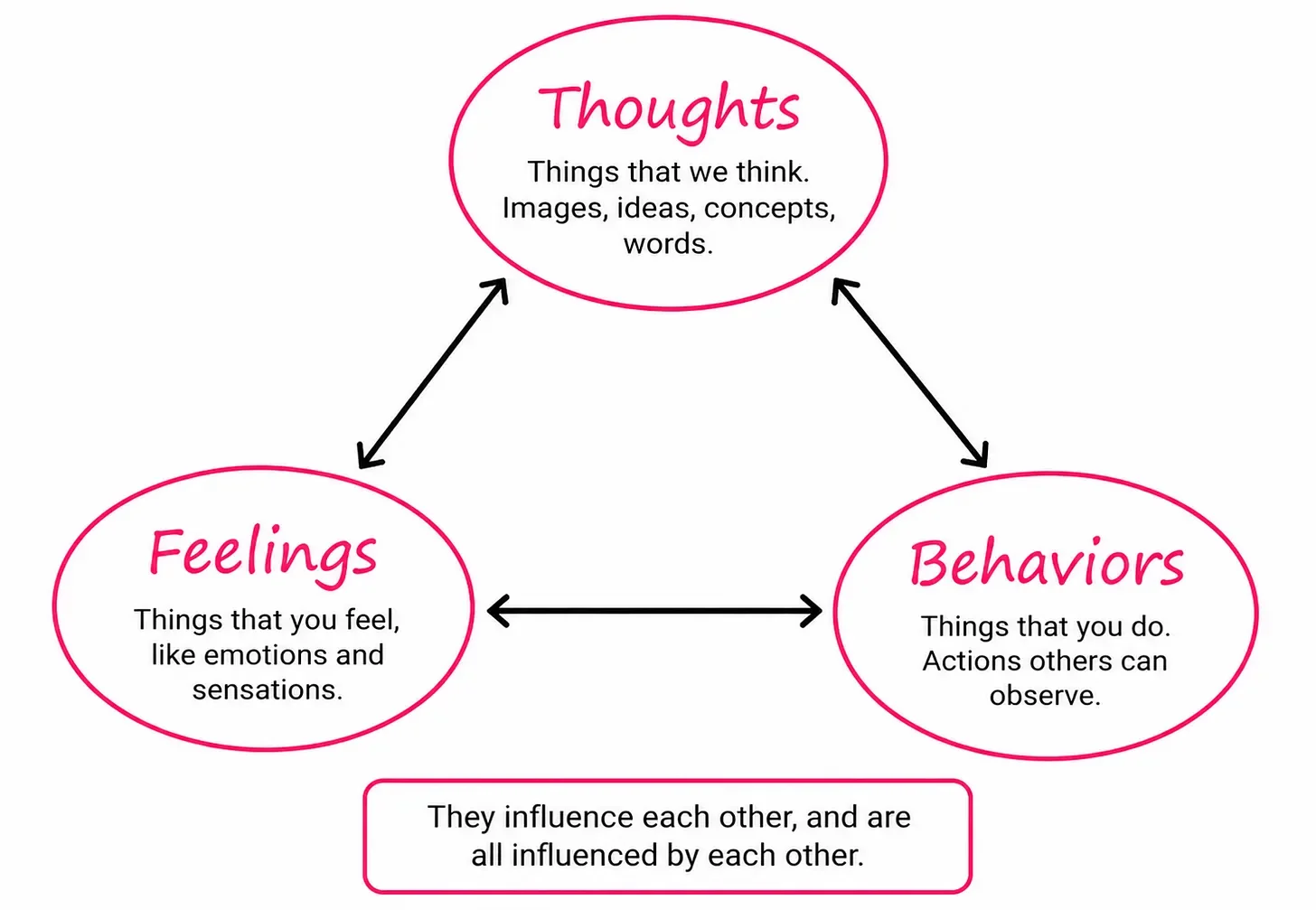
Psychology 101: Thoughts are things that we think. Images, Ideas, concepts, words. How you talk to yourself about yourself and the world, ideas you have, these are all thoughts. Behaviours are things that you do. Think of an action as something someone else can observe about you – running, sleeping, walking, talking, writing, etc. If it can be outwardly observed, it is an action. Feelings are things that you feel, like emotions and sensations. For example, stress, fatigue, sadness. You may have certain thoughts associated with your feelings and behaviours, but they are different things. Being able to identify and name them separately has great value. They are all influenced by and influence each other, and while directly changing a feeling is not usually possible or easy, we can influence feelings through things we can control like behaviours and attention given to thoughts (more on this at Cassie’s free full length substack article).